
https://api.overmindlab.ai/api/v1 (or your own host), authenticated with the same ovr_ key you use everywhere else. Frontier models are callable through the same gateway, so comparing your trained model against a hosted one is a change of the model field, not a second integration.
Deployment lifecycle
Deployment starts automatically when a training experiment succeeds. A model moves through Queued → Deploying → Warming → Ready, and only Ready models accept traffic; a failed deployment can be retried without retraining. Undeploy stops serving and scales the GPU pool to zero; the row reads Not deployed and the weights are preserved, so Deploy brings the same model back. Delete has the same effect on the serving side and keeps the archived checkpoint too — a deleted model is retried back into service the same way, or downloaded withovermind model download-checkpoint.
How a model is served depends on how it was trained. A dense model trained as a LoRA adapter on Modal is served as an adapter on a shared BF16 base: every adapter of that base shares one container pool, so a second one deploys in seconds and a cold start is amortised across them. Everything else — full fine-tunes, mixture-of-experts, Baseten-trained models — is merged and FP8-quantised into a private checkpoint with its own pool.
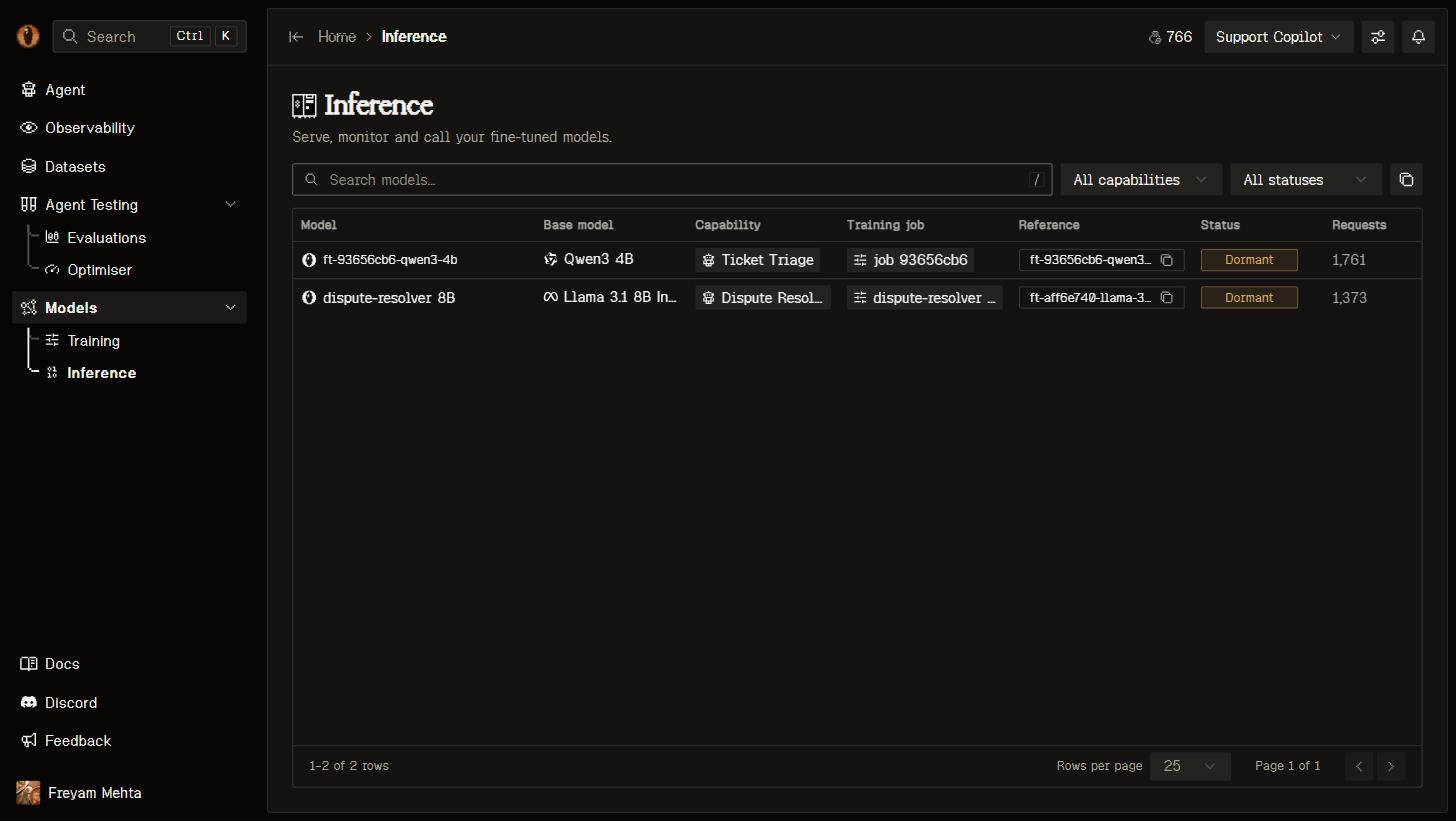
The Inference page: every deployed model with its base model, capability, training run, copyable reference, serving state, and usage.
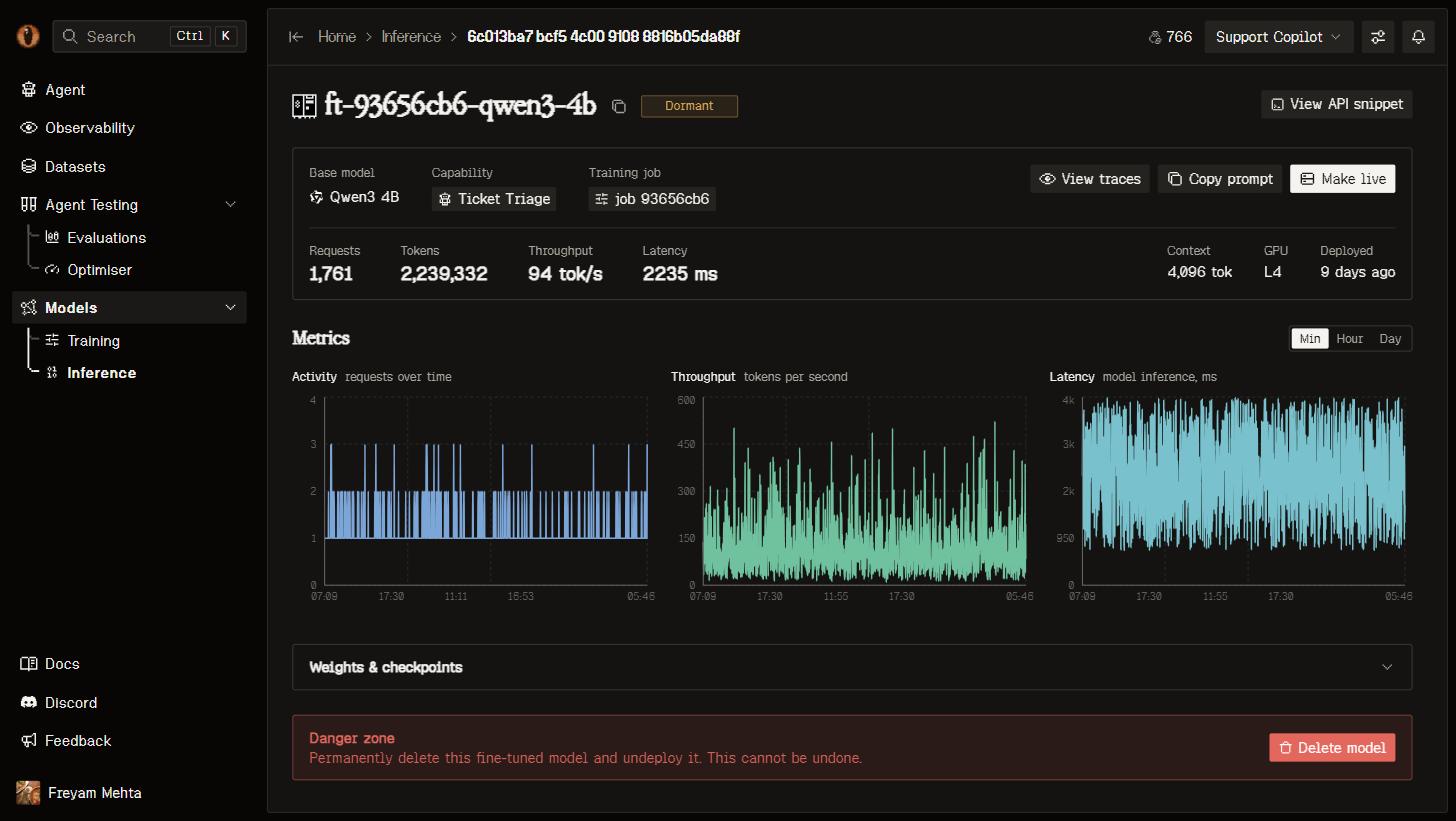
A served model: requests, tokens, activity, throughput and latency over time, and the weights download.
Latency here measures model inference time only, as a median with a p95 tail. Requests that hit a cold model are tracked separately as
cold_start_ms and excluded from the warm figures. A genuine cold boot takes two to seven minutes; while the model warms, the gateway keeps the connection alive with an idle ping every 15 seconds, on streaming and non-streaming requests alike — a non-streaming completion therefore arrives as a chunked response, and a failure that happens after the first ping arrives as an {"error": ...} body under HTTP 200.Calling your model
Use any OpenAI SDK pointed at the base URL, with your model’s reference (copyable from the models table) as the model name — or the capability alias,overmind/<capability-uuid>, which resolves to whichever deployment the capability has made live, so a model switch never touches the calling code:
messages, temperature, max_tokens, top_p, frequency_penalty, presence_penalty, tools, tool_choice, response_format, stream, and stream_options.include_usage — plus reasoning_effort, include_reasoning, and chat_template_kwargs for models that reason. A deployed model gets its family’s reasoning defaults filled in, and max_tokens is raised to the family floor when it is too small to hold a reasoning trace.
Endpoints
The gateway routes by model id: your
ft-... references and overmind/... aliases go to Overmind’s serving infrastructure; frontier ids (openai/..., anthropic/..., google/..., x-ai/..., deepseek/..., meta-llama/..., qwen/...) go to OpenRouter under the platform’s key and are metered as inference. Every call appears in the model’s usage metrics. The models list is the live source of truth for what you can call; the Model Library covers the base models behind your trained ones, with parameters, context windows, and pricing.