Sign up or self-host, paste one prompt into your coding agent — then improve the agent with /overmind commands.
Overmind onboards through your coding agent. One pasted prompt installs the SDK, configures the MCP server, and scans your repository into capabilities; after that, everything — instrumentation, datasets, training, optimisation — runs as /overmind commands from the same chat.
1
Get a console
Sign up at console.overmindlab.ai, or start the stack locally with docker compose up — see Self-hosting. A project is the scoping unit for capabilities, traces, datasets, runs, models, and keys; the first scan push creates it for you.
2
Copy the onboarding prompt
The Agent page opens empty. Pick your coding agent — Cursor, Claude Code, OpenCode, or Codex — and hit Copy onboarding prompt. The prompt carries a temporary account-scoped bootstrap key, so paste it only into your local coding agent, never into a shared chat. Manual setup shows the same commands for a terminal.
3
Paste it into your coding agent
Open your repository in the coding agent (repo root as the workspace folder) and paste. The agent does the rest:
installs the overmind package with your repo’s own package manager
exports OVERMIND_API_URL and the bootstrap key for this shell session only
runs overmind init --ide <client> — installs the Overmind skill, the /overmind commands (Cursor and Claude Code), and the client’s MCP entry
runs overmind scan — a deterministic local scan that writes .overmind/skeleton.json, worksheet.json and report.json — then names every cluster in the worksheet from the evidence
runs overmind scan finalize — writes the declared capabilities into overmind.toml and stubs one card per capability — and fills the cards from your source
runs overmind scan push — creates the Console project, saves a project-scoped key to .overmind/credentials.toml, and rewrites the MCP entry with it
follows the installed skill’s onboard reference for tracing
Reload the IDE once after the push. The bootstrap key is never written to project files; local runs reuse the saved project credential from then on. Against a self-hosted API, the same prompt exports OVERMIND_API_URL first and overmind init takes --env local. What each scan step produces is on Agent & Capabilities.
4
Improve the agent with /overmind commands
The pushed capabilities are the starting point. From the same chat, each command drives one loop end to end:
Command
What it does
/overmind onboard
Connect this repository to Overmind
/overmind setup
Scan the repository and declare capabilities
/overmind ensure-tracing
Inspect traces and instrument the agent
/overmind dataset
Build, clean, upload, or export a dataset
/overmind finetune
Fine-tune, deploy, and smoke-test a model
/overmind optimise
Run prompt and code optimisation
/overmind backtest
Compare models in the repository
Plain /overmind routes to the right workflow when you’d rather describe the goal than pick a command. OpenCode and Codex get the same skill and MCP entry but no slash commands; describe the goal instead.
5
Watch it land in the Console
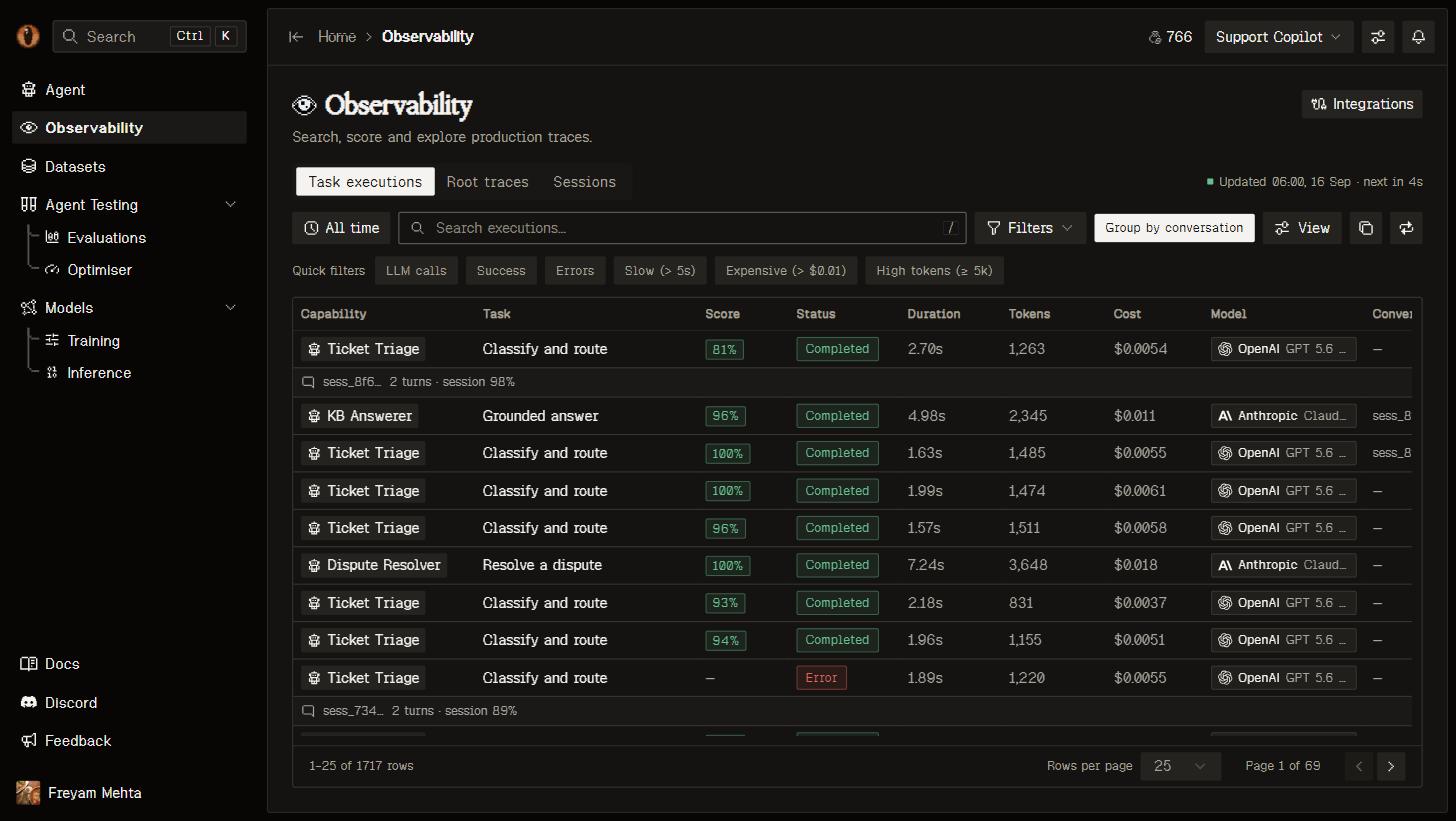
Once tracing is in, open Observability. The default Task executions view shows one row per scored unit of work; Root traces shows one row per trace and Sessions groups traces by session. Click a row for the span tree, timeline, full model-call transcripts, and the verdicts with their reasoning.
Task executions: one row per scored unit, with the task it bound to and its execution score.
The Agent page fills in as each step lands: capabilities after the first push, traffic and scores once traces arrive, Confirmed on a capability once a trace binds to it.
Deployed processes still need OVERMIND_API_KEY in their runtime secret configuration — the saved project credential covers local runs only. Not using Python or a coding agent? Any OpenTelemetry SDK can export straight to the OTLP endpoint.