> ## Documentation Index
> Fetch the complete documentation index at: https://docs.overmindlab.ai/llms.txt
> Use this file to discover all available pages before exploring further.
# Agent & Capabilities
> How Overmind models your agent — one graph per project, made of capabilities discovered by a local scan, described by agent-authored cards, and confirmed by telemetry.
export const Ascii = ({lines}) => {lines.join("\n")};
Your **agent** in Overmind is the product itself: one per project, mapped as a graph of **capabilities**. A capability is one purpose the product serves — triage tickets, answer from the knowledge base, resolve a dispute. Each capability record joins two sides: static structure from your repository (entry points, prompts, tools, modes, call edges) and runtime behaviour from telemetry (traces, task executions, live scores). Everything else on the platform hangs off capabilities — traces bind to one, datasets are aligned to one, eval sets belong to one, optimisation runs edit a capability's code, and trained models are benchmarked against the model a capability runs in production.
## How capabilities get into Overmind
### The scan
Discovery runs in your repository, not on the server. `/overmind setup` in your coding agent drives it; `overmind chassis` and `overmind sync` are the CLI halves. See the [CLI](/platform/cli).
Prints a deterministic AST inventory of Python functions and call edges under the repository root. `/overmind setup` runs this first; the digest is ground truth the cards must not contradict.
The coding agent reads the source against that chassis and writes one capability per product purpose into `overmind.toml` — name, slug, entry point, prompt, tools, and a **card**: task, input/output contract, success criteria, failure modes, and a trajectory map of anchors with `file#Lstart-Lend` provenance. Roles inside one orchestration — a crew, a graph of workers, a supervisor with specialists — are **modes** of the one capability that orchestration serves, not separate capabilities. There is no server-side model call.
POSTs `overmind.toml` to `POST /api/v1/sync`. The response carries assigned capability ids, and the CLI writes them back. The first sync with an account-scoped key creates the project and mints the project-scoped key the MCP entry uses.
After code changes: `/overmind setup` again, then `overmind sync`. A trajectory entry whose anchors are not call-graph reachable from its entry is stamped `verified = false`.
### What the server does with a sync
`POST /api/v1/sync` reconciles the snapshot with the project's capabilities. Then, per capability:
* **Identity is carried**, in order: the toml `id` → the toml `slug` → a new record. A capability the push no longer includes becomes a leftover (`archived = true` in the toml on the next `sync down`).
* **Behaviours are minted from the trajectory map**: one contract per mapped route, with an entry anchor, the ordered anchors that follow it, and its tool set. Behaviours are what [trace scoring](/agent-testing/trace-scoring#behaviours-and-bindings) binds production traffic to; the Console labels the column **Task**.
* **The Default eval set is preloaded** for every created, remounted or card-changed capability: Tier-0 rule-based checks compiled from the card, Tier-1 generative LLM judges grounded in it, and per-behaviour outcome and step judges for trace scoring. See [Eval](/agent-testing/eval#authoring).
### A scan never deletes
A capability the push no longer includes becomes a **leftover**: it keeps its id and data, leaves the agent view, shows a **Not in latest scan** badge, and remounts in place when a later push reproduces it. `slug` in `overmind.toml` is the server identity — rename a capability by editing `name`, never `slug`.
To remove a capability yourself, use **Delete capability** at the bottom of its page (`DELETE /api/capabilities/{id}/`). The record is soft-deleted: it leaves lists, scans and identity lookup, its traces, datasets and runs stay, and its inference alias stops serving. Because a deleted capability is invisible to later syncs, the next push of the same code mints a fresh record.
### Telemetry
Spans carrying `overmind.capability.id` — set with [`init(capability_id=...)`](/tracing/sdk-python#init) or a `capability(..., id=)` scope — bind to that capability. The value is the capability's UUID or its toml `slug`; both resolve, and both are stable through renames. `overmind.capability.name` is a display label and never binds.
Ingest never creates a capability. An identity the project does not know leaves the span **unbound**: it is stored, browsable under Observability's Unbound filter, and binds retroactively when a later push makes the identity resolvable. `confirmed_at` is stamped on the capability the first time a span binds to one of its behaviours; the capability page shows **Confirmed** or **Unconfirmed** accordingly. A capability created by hand (`POST /api/capabilities/`) carries an **Observed** badge instead, because no scan can confirm or retire it.
## The agent page
**Agent** in the sidebar opens the product view: the capability grid, or the onboarding prompt while the project is still empty. Open a capability for its page.
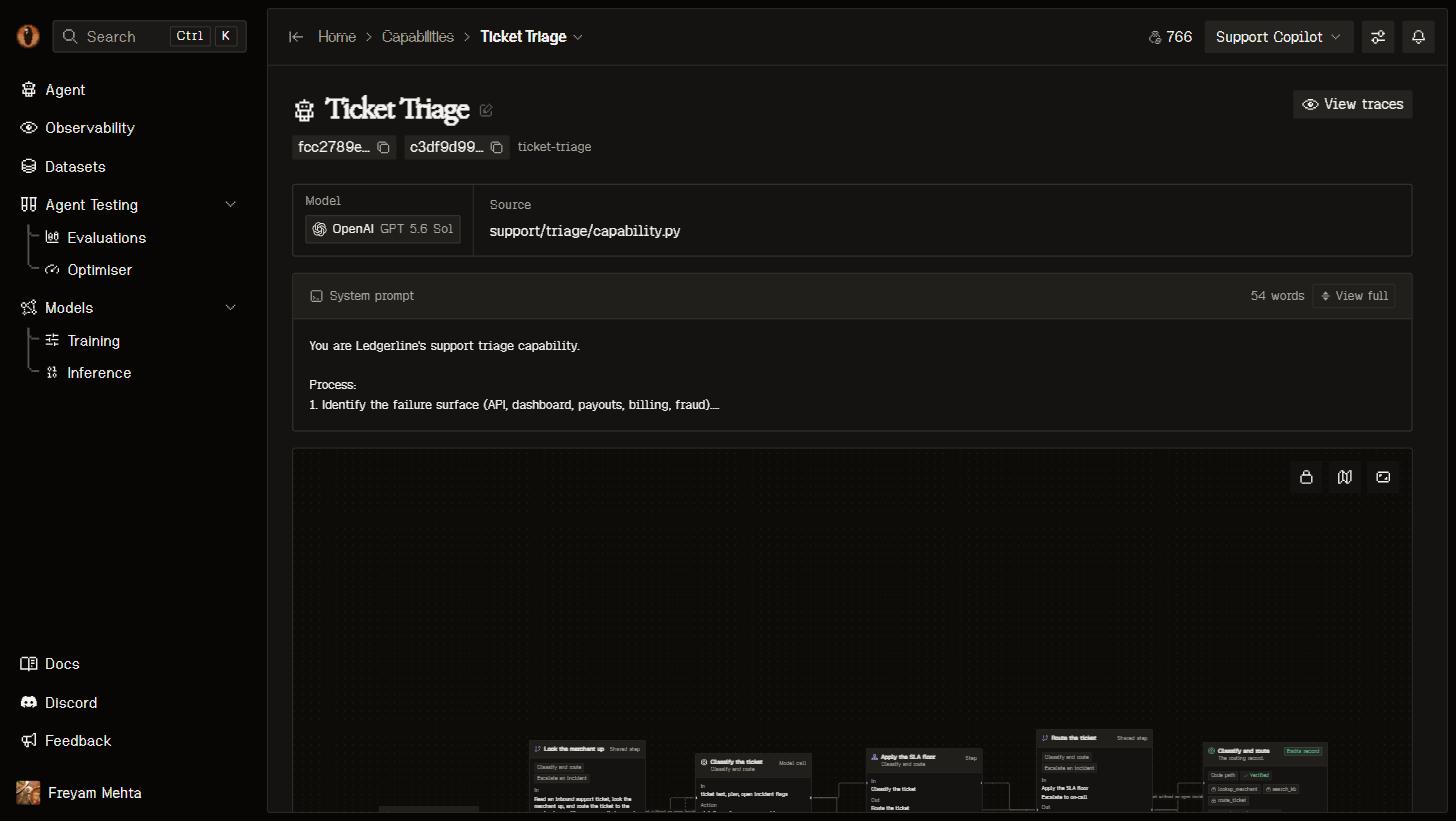
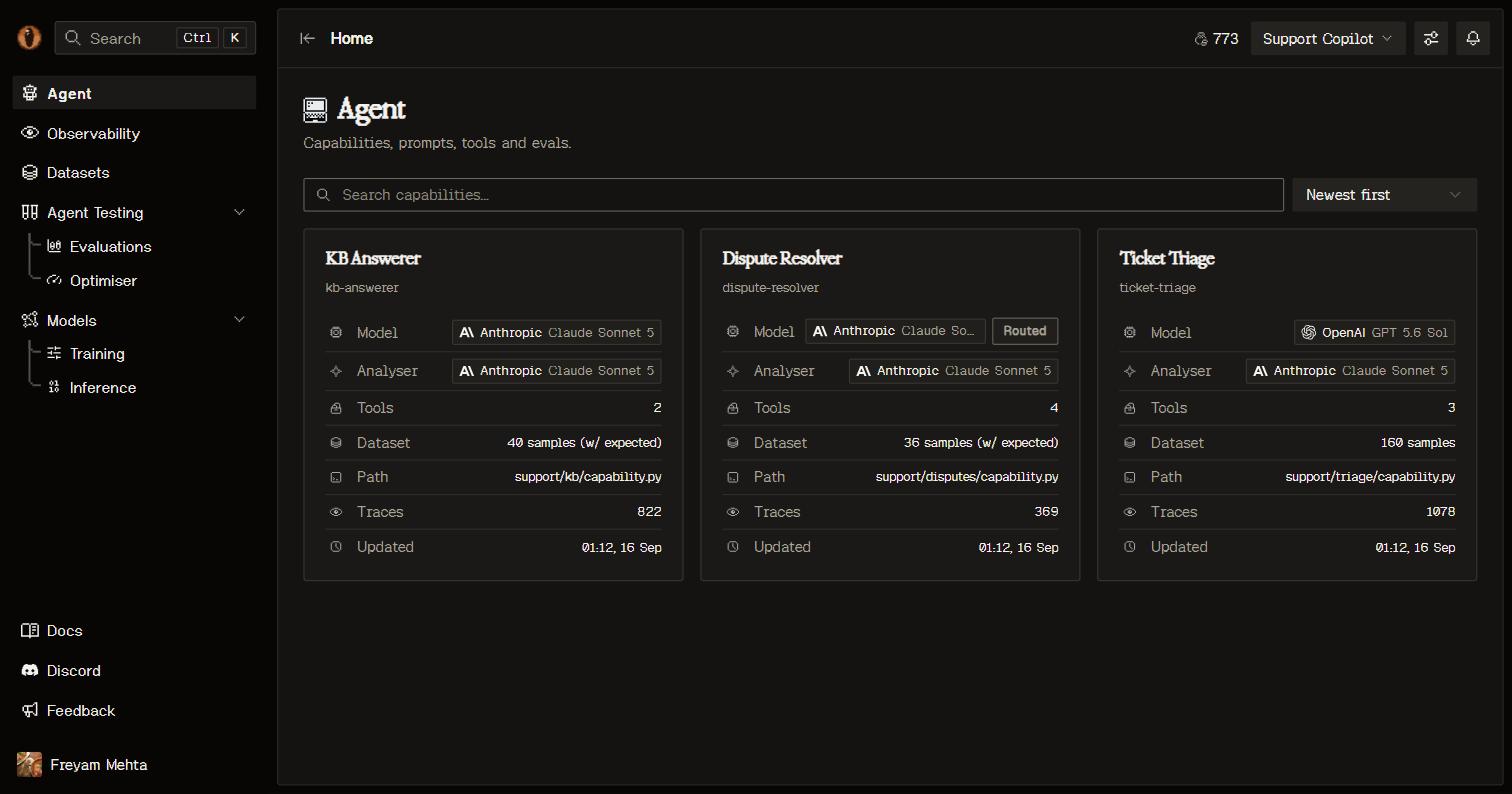 The header carries the name (editable in place), copyable **capability id** and **project id** chips, the slug, the badges — **Declared** or **Inferred** (whether the manifest named it), **Confirmed** or **Unconfirmed**, **Not in latest scan** — and a **Last push** line linking to the project's scan report. **View traces** opens the capability's filtered Observability view. Below it, one scrolling page:
* **Facts** — the model the capability serves through (or the live deployed model behind its alias) and its source path.
* **Prompt** — the system prompt lifted from your code, one per mode when the capability has several.
* **Trajectory map** — the entry point, each behaviour's steps with the tools they may use, and its terminal, as an interactive graph.
* **Components** — every anchor, tool and utility the scan found, with file-level provenance.
* **Dataset** — datasets aligned to this capability. See [Datasets](/core/datasets).
* **Eval metrics** — the capability's eval sets and evaluators, with score history over its runs. See [Eval](/agent-testing/eval).
* **Models** — the production model and any models trained on this capability's data, linking into [Models](/models/training) and [Inference](/models/inference).
The header carries the name (editable in place), copyable **capability id** and **project id** chips, the slug, the badges — **Declared** or **Inferred** (whether the manifest named it), **Confirmed** or **Unconfirmed**, **Not in latest scan** — and a **Last push** line linking to the project's scan report. **View traces** opens the capability's filtered Observability view. Below it, one scrolling page:
* **Facts** — the model the capability serves through (or the live deployed model behind its alias) and its source path.
* **Prompt** — the system prompt lifted from your code, one per mode when the capability has several.
* **Trajectory map** — the entry point, each behaviour's steps with the tools they may use, and its terminal, as an interactive graph.
* **Components** — every anchor, tool and utility the scan found, with file-level provenance.
* **Dataset** — datasets aligned to this capability. See [Datasets](/core/datasets).
* **Eval metrics** — the capability's eval sets and evaluators, with score history over its runs. See [Eval](/agent-testing/eval).
* **Models** — the production model and any models trained on this capability's data, linking into [Models](/models/training) and [Inference](/models/inference).
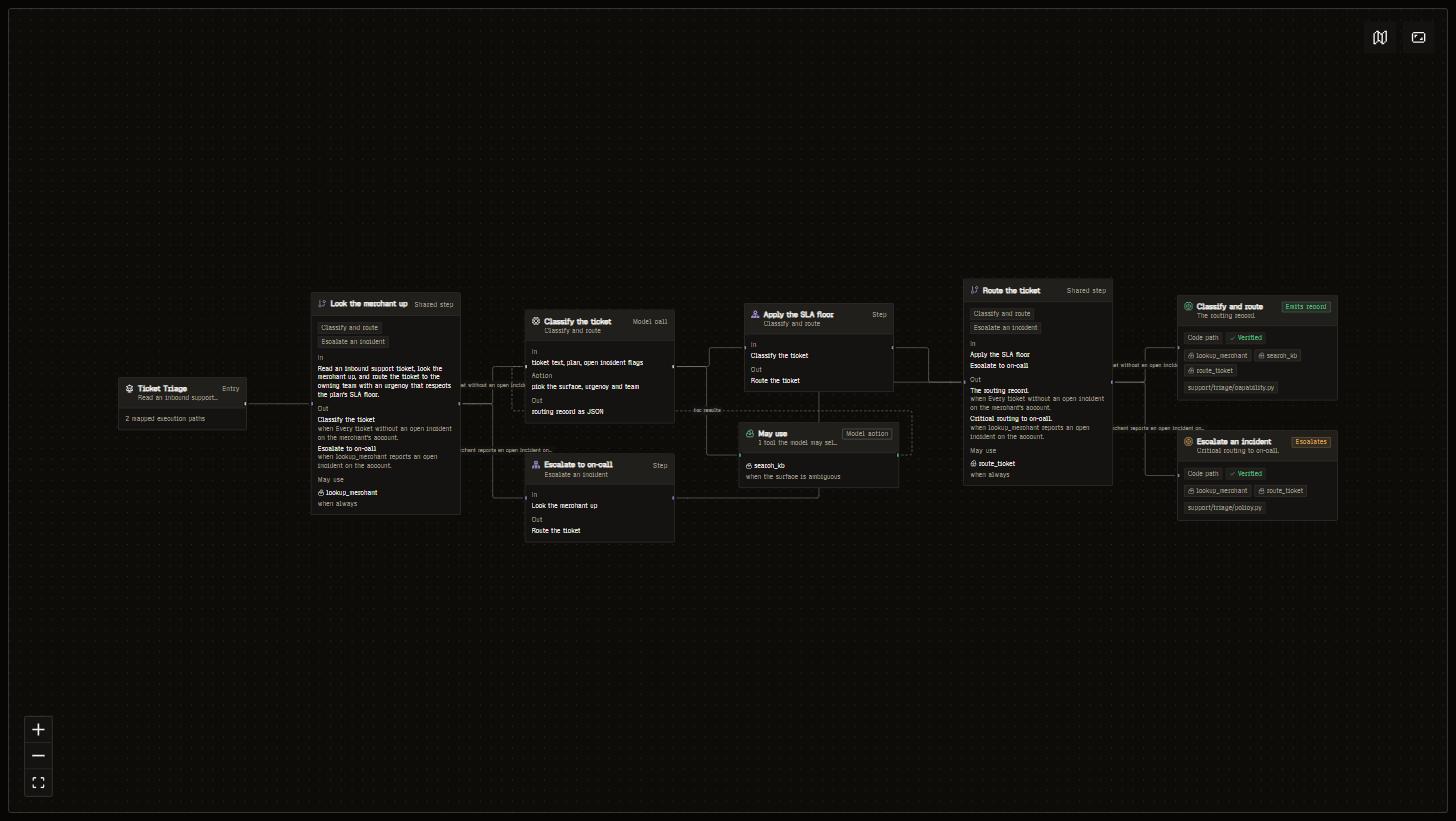 The Agent page is the record of the latest sync: each capability with its card, behaviours, and whether telemetry has confirmed it.
## Instrumentation
Which of a capability's anchors emit telemetry is answered by the traces themselves: a task execution's route shows the contract anchors it matched, and a behaviour with no executions has none. To close a gap, ask your coding agent: the `get_instrumentation_plan` MCP tool returns placement tickets (file, qualname, decorator, required scope) for the project or one capability, and `verify_instrumentation` grades a fresh trace against the contract without writing anything. The `/overmind ensure-tracing` command runs that loop. See [MCP](/platform/mcp).
## API
```bash theme={"dark"}
# The whole agent graph: current capabilities, their edges, and the latest scan
curl -H "X-Api-Key: $OVERMIND_API_KEY" "https://api.overmindlab.ai/api/agent/?project={project_id}"
# List capabilities / one capability
curl -H "X-Api-Key: $OVERMIND_API_KEY" "https://api.overmindlab.ai/api/capabilities/"
curl -H "X-Api-Key: $OVERMIND_API_KEY" "https://api.overmindlab.ai/api/capabilities/{id}/"
# The evaluation spec and the selectable system prompts
curl -H "X-Api-Key: $OVERMIND_API_KEY" "https://api.overmindlab.ai/api/capabilities/{id}/eval_spec/"
curl -H "X-Api-Key: $OVERMIND_API_KEY" "https://api.overmindlab.ai/api/capabilities/{id}/prompts/"
# Behaviours and how well the eval set covers each one
curl -H "X-Api-Key: $OVERMIND_API_KEY" "https://api.overmindlab.ai/api/behaviours/"
curl -H "X-Api-Key: $OVERMIND_API_KEY" "https://api.overmindlab.ai/api/behaviours/coverage/?capability={id}"
# Pull the reconciled snapshot (leftovers come back archived)
curl -H "X-Api-Key: $OVERMIND_API_KEY" "https://api.overmindlab.ai/api/v1/sync?project_id={project_id}"
```
`GET /api/capabilities/` returns current capabilities unless `?status=` asks for leftovers. `PATCH /api/capabilities/{id}/` updates mutable fields, including `model` and `active_model`. `POST /api/v1/sync` is what `overmind sync` speaks; it takes API-key auth and requires `project_id` to be in the key's scope (a project-scoped key supplies its one project). Through MCP: `inspect_capability_health`, `query_failures`, and the `overmind://capabilities/{capability}` resource. See the [REST API](/platform/api) for the full surface.
## Good to know
* **The baseline matters.** The capability's `model` field is what training benchmarks and optimiser baselines measure against. The card is where the model gets named when the codebase resolves models through a role chain rather than a literal.
* **Commit `overmind.toml`.** It carries the ids and the authored cards that keep identity and semantics stable across syncs. `.overmind/credentials.toml` holds the project key and is excluded from git by `overmind sync`.
* **Pin identity in code.** `overmind.init(capability_id="")` or a `capability(..., id=)` scope stamps `overmind.capability.id` on every span inside. Ingest binds by that id alone.
The Agent page is the record of the latest sync: each capability with its card, behaviours, and whether telemetry has confirmed it.
## Instrumentation
Which of a capability's anchors emit telemetry is answered by the traces themselves: a task execution's route shows the contract anchors it matched, and a behaviour with no executions has none. To close a gap, ask your coding agent: the `get_instrumentation_plan` MCP tool returns placement tickets (file, qualname, decorator, required scope) for the project or one capability, and `verify_instrumentation` grades a fresh trace against the contract without writing anything. The `/overmind ensure-tracing` command runs that loop. See [MCP](/platform/mcp).
## API
```bash theme={"dark"}
# The whole agent graph: current capabilities, their edges, and the latest scan
curl -H "X-Api-Key: $OVERMIND_API_KEY" "https://api.overmindlab.ai/api/agent/?project={project_id}"
# List capabilities / one capability
curl -H "X-Api-Key: $OVERMIND_API_KEY" "https://api.overmindlab.ai/api/capabilities/"
curl -H "X-Api-Key: $OVERMIND_API_KEY" "https://api.overmindlab.ai/api/capabilities/{id}/"
# The evaluation spec and the selectable system prompts
curl -H "X-Api-Key: $OVERMIND_API_KEY" "https://api.overmindlab.ai/api/capabilities/{id}/eval_spec/"
curl -H "X-Api-Key: $OVERMIND_API_KEY" "https://api.overmindlab.ai/api/capabilities/{id}/prompts/"
# Behaviours and how well the eval set covers each one
curl -H "X-Api-Key: $OVERMIND_API_KEY" "https://api.overmindlab.ai/api/behaviours/"
curl -H "X-Api-Key: $OVERMIND_API_KEY" "https://api.overmindlab.ai/api/behaviours/coverage/?capability={id}"
# Pull the reconciled snapshot (leftovers come back archived)
curl -H "X-Api-Key: $OVERMIND_API_KEY" "https://api.overmindlab.ai/api/v1/sync?project_id={project_id}"
```
`GET /api/capabilities/` returns current capabilities unless `?status=` asks for leftovers. `PATCH /api/capabilities/{id}/` updates mutable fields, including `model` and `active_model`. `POST /api/v1/sync` is what `overmind sync` speaks; it takes API-key auth and requires `project_id` to be in the key's scope (a project-scoped key supplies its one project). Through MCP: `inspect_capability_health`, `query_failures`, and the `overmind://capabilities/{capability}` resource. See the [REST API](/platform/api) for the full surface.
## Good to know
* **The baseline matters.** The capability's `model` field is what training benchmarks and optimiser baselines measure against. The card is where the model gets named when the codebase resolves models through a role chain rather than a literal.
* **Commit `overmind.toml`.** It carries the ids and the authored cards that keep identity and semantics stable across syncs. `.overmind/credentials.toml` holds the project key and is excluded from git by `overmind sync`.
* **Pin identity in code.** `overmind.init(capability_id="")` or a `capability(..., id=)` scope stamps `overmind.capability.id` on every span inside. Ingest binds by that id alone.