> ## Documentation Index
> Fetch the complete documentation index at: https://docs.overmindlab.ai/llms.txt
> Use this file to discover all available pages before exploring further.
# Trace scoring
> How a production trace becomes scored task executions — units, behaviours, verdicts, the execution score, and session scores.
export const Ascii = ({lines}) => {lines.join("\n")};
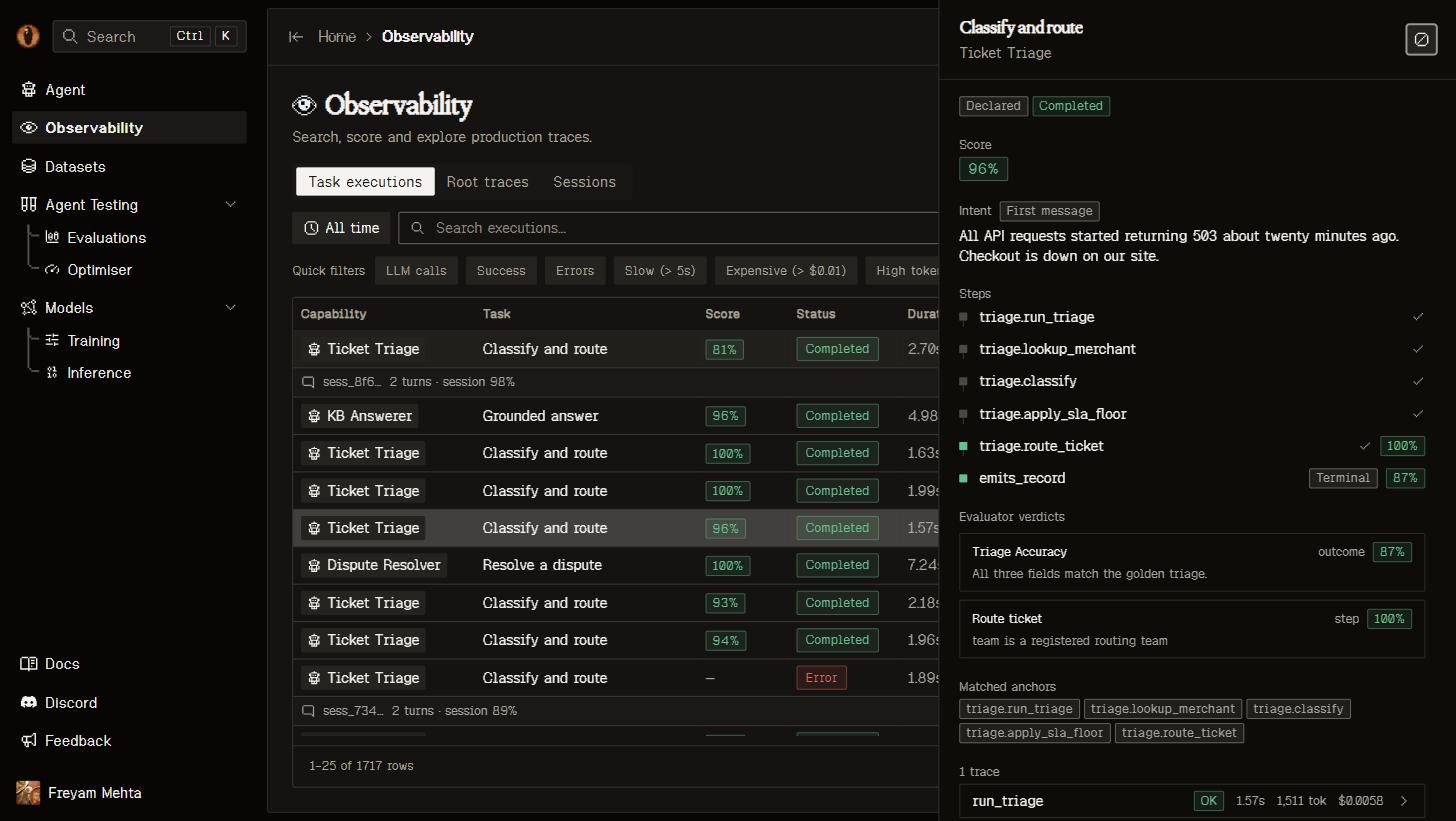
Every trace that reaches Overmind is scored against the owning capability's active [eval set](/agent-testing/eval#eval-sets). Scoring does not grade the trace as one blob: it carves the trace into **units**, binds each unit to one of the capability's **behaviours**, judges each unit on its own, and rolls the results up into an **execution score** per unit and a **session score** per conversation. This page is the contract behind the **Task executions** view in [Observability](/core/observability#what-you-see-in-the-console).
## When a trace is scored
Scoring is queued the moment a trace's root span lands. A trace is **live** while spans are still arriving or while it has no root span yet, **completed** once the root span has landed, and **interrupted** when no root arrives within the settle window (`TRACE_SETTLE_SECONDS`, default 600 s — a killed run never exports its root, because the root ends last). A sweep every 120 s re-checks the last two hours, 200 traces at a time, for traces the immediate pass missed, including interrupted ones; a finished pass is recorded per trace with its verdict counts and cost, and a pass that left verdicts deferred or errored is retried. The trace list and the trace header show the status.
A trace is skipped as a whole, never errored, when it has no spans, when it is an orphan fragment, when no span resolves a capability, when its root span carries an error status and it carved a single unit, or when the capability has no active eval set or the set has no trace-scoring members.
## Units
A unit is the slice of a trace that gets its own verdicts. The carve is a precedence lattice; the first tier that applies wins:
| Tier | Source | What marks it |
| ---- | --------------------------- | ------------------------------------------------------------------------------------------------------------------------ |
| 1 | **Turn spans** | Spans stamped `overmind.unit_kind = "turn"` — `task(..., unit="turn")`, a capability handoff, or an SDK-bound graph node |
| 2 | **Entry-point invocations** | Each `entry_point` span (`overmind.unit_kind = "run"`); several in one trace are scored separately |
| 3 | **Key segments** | A flat trace whose spans declare two or more distinct behaviour keys, one unit per key |
| 4 | **Root** | The whole trace as one unit |
Tiers 1–3 exclude the root. In a multi-entry trace, interior turn units fold into the enclosing execution as **step coverage** rather than scoring twice; a run boundary that encloses turn slices is offered again as a run-grain surface and kept only when a run-grain behaviour binds it. A single `function` span that starts its own trace outside any declared boundary is an orphan fragment and is skipped; a lone untyped span still scores.
The span carrying `overmind.delivery = true` — `deliver()` in the SDK — is the unit's terminal deliverable; without it the platform picks the terminal span heuristically.
## Behaviours and bindings
A **behaviour** is one contract a capability performs, minted by [`overmind sync`](/core/capabilities#the-scan) from the trajectory map: an entry anchor, the ordered anchor segments that follow it, its tool set, and its terminal. Behaviours keep their identity across syncs through their key.
Each unit binds to one behaviour, recorded as a **task execution** with a `binding_source`:
* `declared` — the span carried `overmind.behaviour.key` (`overmind.task("")`). A declared key whose grain disagrees with the unit — a turn's key stamped on a whole run — is refused and falls through to the anchor join, with a `declared_grain_mismatch` flag on the execution.
* `anchor_join` — the unit's `code.namespace` / `code.function.name` stamps matched the behaviour's anchors; the binder tolerates dotted-suffix differences and prefers the version analysed at the trace's `vcs.ref.head.revision`.
* `unbound` — nothing matched. The execution still materialises, and the unit still scores against the capability's set; members bound to a behaviour are skipped on it.
A trace whose units resolve to different capabilities (a handoff) scores each unit under its own capability's eval set — never smeared from the root's capability.
## Verdicts and the execution score
The eval set's `trace_scoring` members run per unit. Every evaluator carries a [claim](/agent-testing/eval#claims) — a type and a grain — and the claim decides how its verdict composes:
* **Safety** claims cap the score: the composite never reads higher than the worst cap verdict, and the marker names `cap_evaluator` and `failure_mode_cap`.
* **Conformance** and **verification** claims flip their own verdict's `passed` when they fail; no member vetoes the rest.
* **Progress**, **quality**, and **grounding** claims are scoring leaves.
* Every verdict feeds one of three phases by grain — **steps** (weight 0.25), **trajectory** (0.25), and **output** (0.50) — and an empty phase's weight is redistributed proportionally to the others.
* Two output-phase verdicts more than 0.5 apart never average silently: the marker carries a `conflict` with the lane, the spread and both members' values, and the Console shows it on the row.
Each verdict is stored as its own `Verdict` row: evaluator, target span, typed outcome, score, `passed`, `explanation`, `unmet` clauses, `scope`, `grain`, `gate`, `sub_scores`, `identifier`, cost and latency. Verdict rows are the source of truth — every detail surface reads them over `GET /api/verdicts/`. The unit's span keeps only the composed markers, written to `feedback_score.trace_scoring` as a derived cache the list views read:
```json theme={"dark"}
{
"trace_scoring": {
"_execution": {"score": 0.85, "phases": {...}, "evaluations": 4, "not_applicable": 0, "any_failed": false},
"_skipped_members": ["tool-hygiene"],
"_scored_at": "..."
}
}
```
`_execution.score` (0–1) is the composite the Console shows as the **Score** column. A trace with several entry-point invocations scores each unit onto its own span; the root span gets only an `invocations` summary entry (`"2/2 invocations passed"`) and an `_execution` that averages the unit scores.
Verdict outcomes are `scored`, `abstained`, `not_applicable`, or `error`, and only `scored` verdicts feed the composite. A member whose evidence the trace cannot supply abstains rather than guessing; a member skipped for its grain, a behaviour filter, or an interrupted run persists a retryable `not_applicable` row whose `unmet` list carries `skip:grain`, `skip:behaviour-filter`, or `skip:interrupted`. A skip row never settles its series: it is overwritten when the member dispatches on that unit. An interrupted skip is the one case that overwrites a real verdict, since a delivery grade on a run that never delivered is stale by rule.
 ## Session scores
Traces sharing a `conversation.id` form a session. Each scored turn appends **conversation events** to a ledger: `ask_opened`, `ask_superseded`, `ask_reprompted`, `delivered`, `delivered_wrong`, `refused`, and `parked` (a turn that stopped to confirm before a gated write). The **session score** is a fold over that ledger: an open `produce` ask, or a `produce` ask delivered wrong and never delivered afterwards, zeroes the session; a re-prompt reopens a refused or superseded ask. The execution carries `session_score` and `session_rationale`, and the **Sessions** view rolls them up.
## Runtime expectations from the SDK
The SDK can declare evidence at run time; the platform reads it from span events and evaluates it server-side:
| Call | Effect |
| ------------------------------------------------- | -------------------------------------------------------------------------------------------------------------------------------------------------------------------------------------- |
| `overmind.intent(text)` | The user's ask for this run; judges ground in it instead of the first user message |
| `overmind.expect(kind, spec, id=, scope=, gate=)` | A declared expectation (`contains`, `regex`, `schema`, `constraint`, `checkpoints`) with scope `span`, `trace`, or `conversation`, checked as a predicate; `gate=True` makes it a gate |
| `overmind.checkpoint(name)` | A named milestone the trajectory must reach |
| `overmind.eval_context(**facts)` | Facts the judge may use |
| `overmind.end_conversation()` | Closes the session ledger |
See the [Python SDK](/tracing/sdk-python#runtime-expectations) for the calls.
## Reading executions over the API
```bash theme={"dark"}
# Task executions (the row grain of the Observability default view)
curl -H "X-Api-Key: $OVERMIND_API_KEY" \
"https://api.overmindlab.ai/api/task-executions/?capability={id}&binding_source=declared"
curl -H "X-Api-Key: $OVERMIND_API_KEY" "https://api.overmindlab.ai/api/task-executions/{id}/"
curl -H "X-Api-Key: $OVERMIND_API_KEY" \
"https://api.overmindlab.ai/api/task-executions/conversation-turns/?conversation_id={id}"
# Verdicts — the read surface for score detail
curl -H "X-Api-Key: $OVERMIND_API_KEY" "https://api.overmindlab.ai/api/verdicts/?trace_id={trace_id}"
# Behaviours, per-behaviour coverage of the eval set, and the evaluators bound to one behaviour
curl -H "X-Api-Key: $OVERMIND_API_KEY" "https://api.overmindlab.ai/api/behaviours/"
curl -H "X-Api-Key: $OVERMIND_API_KEY" "https://api.overmindlab.ai/api/behaviours/coverage/?capability={id}"
curl -H "X-Api-Key: $OVERMIND_API_KEY" "https://api.overmindlab.ai/api/behaviours/{id}/evaluators/"
```
List filters on `/api/task-executions/`: `project`, `capability`, `behaviour`, `binding_source`, `trace_id`, `status`, `started_at__gte/lte`, `received_at__gte/lte`, `min_duration_ms`, `max_duration_ms`, `has_error`, `service_name`, `operation`, `span_type`, `status_code`, `model`, `has_model`, `total_tokens__gte/lte`, `total_cost__gte/lte`. The list row carries `behaviour_key`, `success_score`, `session_score`, `session_rationale`, `route_flags`, `terminal_kind` and `scoring_pending`. The detail adds `observed_route` (the anchors the unit hit), `step_results` (per-step verdicts), `user_intent`, and the unit's composed markers: `execution_score`, `conflict`, `skipped_members`, and the `flow` (each contract anchor with its match and verdict). Over MCP the same reads are `query_task_executions` and `query_failures`.
`GET /api/verdicts/` lists `Verdict` rows newest-first. Filters: `target_id`, `target_id__in`, `target_kind`, `evaluator_name`, `outcome`, and `trace_id` — every span-target verdict of one trace in a single call.
`GET /api/task-executions/conversation-turns/?conversation_id={id}` returns one row per turn of a conversation, assembled server-side from the executions and their traces' spans: the turn's intent, input and output text, execution and session scores with the session rationale, the task state (outstanding asks, delivered-wrong flag), per-step results, and the tool calls with their inputs and outputs.
`GET /api/behaviours/coverage/?capability={id}` returns, per behaviour, the outcome evaluators and whether the outcome is covered, plus each anchor segment with the step evaluators bound to it.
## Session scores
Traces sharing a `conversation.id` form a session. Each scored turn appends **conversation events** to a ledger: `ask_opened`, `ask_superseded`, `ask_reprompted`, `delivered`, `delivered_wrong`, `refused`, and `parked` (a turn that stopped to confirm before a gated write). The **session score** is a fold over that ledger: an open `produce` ask, or a `produce` ask delivered wrong and never delivered afterwards, zeroes the session; a re-prompt reopens a refused or superseded ask. The execution carries `session_score` and `session_rationale`, and the **Sessions** view rolls them up.
## Runtime expectations from the SDK
The SDK can declare evidence at run time; the platform reads it from span events and evaluates it server-side:
| Call | Effect |
| ------------------------------------------------- | -------------------------------------------------------------------------------------------------------------------------------------------------------------------------------------- |
| `overmind.intent(text)` | The user's ask for this run; judges ground in it instead of the first user message |
| `overmind.expect(kind, spec, id=, scope=, gate=)` | A declared expectation (`contains`, `regex`, `schema`, `constraint`, `checkpoints`) with scope `span`, `trace`, or `conversation`, checked as a predicate; `gate=True` makes it a gate |
| `overmind.checkpoint(name)` | A named milestone the trajectory must reach |
| `overmind.eval_context(**facts)` | Facts the judge may use |
| `overmind.end_conversation()` | Closes the session ledger |
See the [Python SDK](/tracing/sdk-python#runtime-expectations) for the calls.
## Reading executions over the API
```bash theme={"dark"}
# Task executions (the row grain of the Observability default view)
curl -H "X-Api-Key: $OVERMIND_API_KEY" \
"https://api.overmindlab.ai/api/task-executions/?capability={id}&binding_source=declared"
curl -H "X-Api-Key: $OVERMIND_API_KEY" "https://api.overmindlab.ai/api/task-executions/{id}/"
curl -H "X-Api-Key: $OVERMIND_API_KEY" \
"https://api.overmindlab.ai/api/task-executions/conversation-turns/?conversation_id={id}"
# Verdicts — the read surface for score detail
curl -H "X-Api-Key: $OVERMIND_API_KEY" "https://api.overmindlab.ai/api/verdicts/?trace_id={trace_id}"
# Behaviours, per-behaviour coverage of the eval set, and the evaluators bound to one behaviour
curl -H "X-Api-Key: $OVERMIND_API_KEY" "https://api.overmindlab.ai/api/behaviours/"
curl -H "X-Api-Key: $OVERMIND_API_KEY" "https://api.overmindlab.ai/api/behaviours/coverage/?capability={id}"
curl -H "X-Api-Key: $OVERMIND_API_KEY" "https://api.overmindlab.ai/api/behaviours/{id}/evaluators/"
```
List filters on `/api/task-executions/`: `project`, `capability`, `behaviour`, `binding_source`, `trace_id`, `status`, `started_at__gte/lte`, `received_at__gte/lte`, `min_duration_ms`, `max_duration_ms`, `has_error`, `service_name`, `operation`, `span_type`, `status_code`, `model`, `has_model`, `total_tokens__gte/lte`, `total_cost__gte/lte`. The list row carries `behaviour_key`, `success_score`, `session_score`, `session_rationale`, `route_flags`, `terminal_kind` and `scoring_pending`. The detail adds `observed_route` (the anchors the unit hit), `step_results` (per-step verdicts), `user_intent`, and the unit's composed markers: `execution_score`, `conflict`, `skipped_members`, and the `flow` (each contract anchor with its match and verdict). Over MCP the same reads are `query_task_executions` and `query_failures`.
`GET /api/verdicts/` lists `Verdict` rows newest-first. Filters: `target_id`, `target_id__in`, `target_kind`, `evaluator_name`, `outcome`, and `trace_id` — every span-target verdict of one trace in a single call.
`GET /api/task-executions/conversation-turns/?conversation_id={id}` returns one row per turn of a conversation, assembled server-side from the executions and their traces' spans: the turn's intent, input and output text, execution and session scores with the session rationale, the task state (outstanding asks, delivered-wrong flag), per-step results, and the tool calls with their inputs and outputs.
`GET /api/behaviours/coverage/?capability={id}` returns, per behaviour, the outcome evaluators and whether the outcome is covered, plus each anchor segment with the step evaluators bound to it.