> ## Documentation Index
> Fetch the complete documentation index at: https://docs.overmindlab.ai/llms.txt
> Use this file to discover all available pages before exploring further.
# Optimisers
> The optimisation loop — candidate code diffs generated and replayed in your repository, scored with your eval set on the platform, and the winning diff to apply locally; plus model comparison and hybrid runs.
export const Ascii = ({lines}) => {lines.join("\n")};
The Optimiser takes an agent you can already measure and edits the agent itself. Candidates are real git diffs against your repository — rewritten prompts, sharpened tool descriptions, adjusted control flow — each replayed over your dataset and scored with your evaluators. Only a change that beats the best score so far survives; the winning diff stays on the candidate for you to apply in your repo. The same loop compares models: a **backtest** replays the dataset through each candidate model instead of each candidate diff.
## Prerequisites
Candidates are edits to source, so the capability must be one `overmind sync` created from an entry declared in `overmind.toml`; the CLI resolves `-c ` through that file, and the run records the capability's `entrypoint_fn` as the entrypoint under test. See [Agent & Capabilities](/core/capabilities).
The run replays the agent over the rows of an eval dataset in the same project whose active version fits the **eval** contract; the inputs must be a shape the agent can be invoked with. The dataset's contracts are the only creation gate — a wrong entrypoint signature surfaces at the smoke test. See [Datasets](/core/datasets#contracts).
Candidates are graded by the eval set you pick, or the capability's active eval set by default. The set must belong to the capability. See [Eval](/agent-testing/eval#eval-sets).
Your agent executes in **your** environment, not Overmind's. The loop is driven from your checkout by the `overmind` CLI, and the candidate diffs are written by your coding agent. **Optimiser → New run** in the Console hands you the prompt to paste — **Harness** for prompt and code optimisation, **Backtesting** for model comparison — which the `/overmind optimise` and `/overmind backtest` commands run end to end.
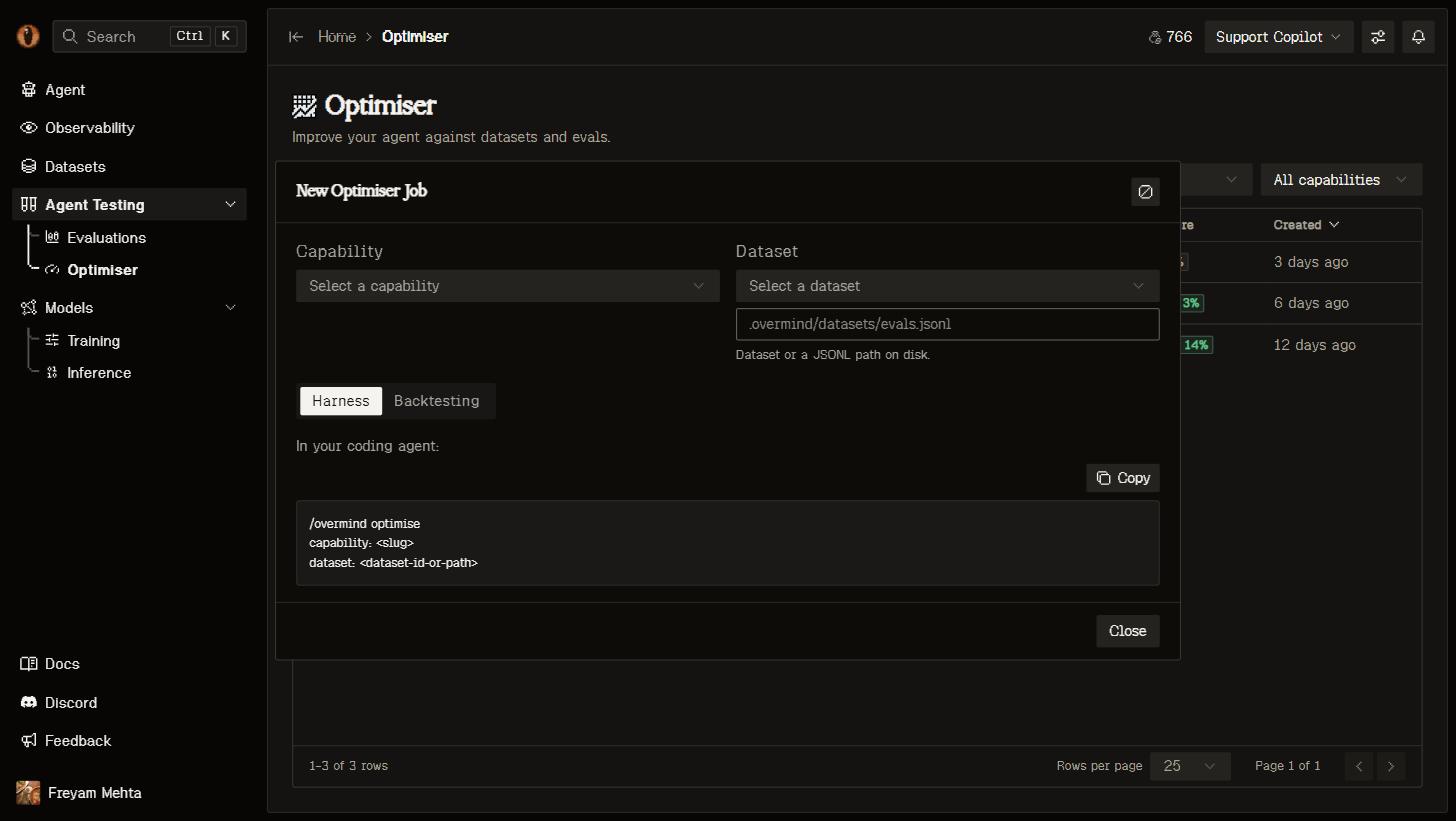 The run's **budget** is the number of iterations (default 5) and candidates per iteration (default 3); patience — consecutive iterations without improvement before early stop — is 3. Starting a run requires credits and counts against the plan's optimiser quota.
## How a run works
The client owns codegen, the smoke test, and every datapoint run; the server holds the dataset version, scores posted outputs, and records the winner. Each step is one CLI verb, and `overmind optimise next` tells the coding agent which one comes next:
```bash theme={"dark"}
overmind optimise start -c -d [--eval-set ] [--mode optimize|hybrid] [-m ...] [--iterations 5] [--candidates 3]
overmind optimise start -e # attach to a run created in the Console or over MCP
overmind optimise next # WRITE_COMMAND_TEMPLATE, RUN_SMOKE, RUN_BASELINE, WRITE_CANDIDATES, RUN_ITERATION, WAIT, COMPLETE or DONE
overmind optimise set-template
overmind optimise run-smoke
overmind optimise run-baseline
overmind optimise add-candidate --diff
overmind optimise run-iteration
overmind optimise status [--json]
overmind optimise complete
```
Every verb takes `-e `; without it the CLI uses the run recorded in `.overmind/optimise_state.json`. `start` pulls the run's dataset version once to `.overmind/datasets/.jsonl` and never re-fetches it. See the [CLI](/platform/cli#overmind-optimise).
The **command template** is one shell command that runs the capability on a single datapoint and prints its output, with placeholders `__DATAPOINT_INPUT__`, `__EXPERIMENT_ID__`, `__CAPABILITY_ID__`, `__CANDIDATE_ID__`, `__ITERATION_ID__`, `__DATAPOINT_INDEX__` and `__PROJECT_ID__`. A run opens with a **smoke test** — before spending anything, the first datapoint runs through the template to verify the entrypoint can be invoked. Then it measures the **baseline**: your agent exactly as it is, scored across the whole dataset as iteration 0.
Each subsequent iteration takes the batch of candidate diffs from the coding agent, applies each in its own git worktree under `.overmind/worktrees/`, replays every datapoint through it — one shared pool of eight workers across all candidates and datapoints — posts the outputs, and waits for the platform to score them with the same eval pipeline used everywhere else: every candidate links to a full [eval run](/agent-testing/eval#eval-runs) you can open. A candidate becomes the new best only if it beats the best score so far. `next` returns `COMPLETE` when the iteration budget is spent or after `patience` consecutive iterations without improvement; `complete` removes the worktrees and closes the run. A run can be cancelled at any point.
## Modes
| Mode | Candidates | Stops on |
| ----------------------------------- | --------------------------------------------------------------------------------------------------------------------- | ---------------------------------------------------- |
| **optimize** (Harness) | Code diffs the coding agent writes | Budget or patience |
| **model\_comparison** (Backtesting) | One to five model ids — OpenRouter slugs or your own `ft-…` deployments — one iteration per model, one candidate each | Every model, always — a comparison owes a full table |
| **hybrid** | Every diff crossed with every model in `--model` | Budget or patience |
A backtest runs the repository with its provider calls redirected to OpenRouter: `overmind.backtest.rewrite_repo(".")` rewrites `OpenAI`, `AsyncOpenAI`, `Anthropic`, `AsyncAnthropic` and `ChatOpenAI` constructors to read `OPENROUTER_MODEL`, `OPENROUTER_API_KEY` and the OpenRouter base URL from the environment, and reports leftover call sites (`ChatAnthropic`, Google GenAI, Vertex) for the coding agent to patch. For each candidate the loop then runs the datapoints with `OPENROUTER_MODEL` set to that candidate's model and `OPENROUTER_API_KEY` from your environment (`OPENAI_API_KEY` as a fallback).
A backtest ranks its candidates **coverage-fair**: by score, then by the share of datapoints that produced gradeable output, then by fewest excluded datapoints (failed runs and empty outputs) — so a model that scored well by failing hard datapoints does not win. The incumbent keeps the overall win on a tie. When every candidate ties and the eval suite left card claims uncovered, no model is selected and the run says so.
## Following a run
The run's **budget** is the number of iterations (default 5) and candidates per iteration (default 3); patience — consecutive iterations without improvement before early stop — is 3. Starting a run requires credits and counts against the plan's optimiser quota.
## How a run works
The client owns codegen, the smoke test, and every datapoint run; the server holds the dataset version, scores posted outputs, and records the winner. Each step is one CLI verb, and `overmind optimise next` tells the coding agent which one comes next:
```bash theme={"dark"}
overmind optimise start -c -d [--eval-set ] [--mode optimize|hybrid] [-m ...] [--iterations 5] [--candidates 3]
overmind optimise start -e # attach to a run created in the Console or over MCP
overmind optimise next # WRITE_COMMAND_TEMPLATE, RUN_SMOKE, RUN_BASELINE, WRITE_CANDIDATES, RUN_ITERATION, WAIT, COMPLETE or DONE
overmind optimise set-template
overmind optimise run-smoke
overmind optimise run-baseline
overmind optimise add-candidate --diff
overmind optimise run-iteration
overmind optimise status [--json]
overmind optimise complete
```
Every verb takes `-e `; without it the CLI uses the run recorded in `.overmind/optimise_state.json`. `start` pulls the run's dataset version once to `.overmind/datasets/.jsonl` and never re-fetches it. See the [CLI](/platform/cli#overmind-optimise).
The **command template** is one shell command that runs the capability on a single datapoint and prints its output, with placeholders `__DATAPOINT_INPUT__`, `__EXPERIMENT_ID__`, `__CAPABILITY_ID__`, `__CANDIDATE_ID__`, `__ITERATION_ID__`, `__DATAPOINT_INDEX__` and `__PROJECT_ID__`. A run opens with a **smoke test** — before spending anything, the first datapoint runs through the template to verify the entrypoint can be invoked. Then it measures the **baseline**: your agent exactly as it is, scored across the whole dataset as iteration 0.
Each subsequent iteration takes the batch of candidate diffs from the coding agent, applies each in its own git worktree under `.overmind/worktrees/`, replays every datapoint through it — one shared pool of eight workers across all candidates and datapoints — posts the outputs, and waits for the platform to score them with the same eval pipeline used everywhere else: every candidate links to a full [eval run](/agent-testing/eval#eval-runs) you can open. A candidate becomes the new best only if it beats the best score so far. `next` returns `COMPLETE` when the iteration budget is spent or after `patience` consecutive iterations without improvement; `complete` removes the worktrees and closes the run. A run can be cancelled at any point.
## Modes
| Mode | Candidates | Stops on |
| ----------------------------------- | --------------------------------------------------------------------------------------------------------------------- | ---------------------------------------------------- |
| **optimize** (Harness) | Code diffs the coding agent writes | Budget or patience |
| **model\_comparison** (Backtesting) | One to five model ids — OpenRouter slugs or your own `ft-…` deployments — one iteration per model, one candidate each | Every model, always — a comparison owes a full table |
| **hybrid** | Every diff crossed with every model in `--model` | Budget or patience |
A backtest runs the repository with its provider calls redirected to OpenRouter: `overmind.backtest.rewrite_repo(".")` rewrites `OpenAI`, `AsyncOpenAI`, `Anthropic`, `AsyncAnthropic` and `ChatOpenAI` constructors to read `OPENROUTER_MODEL`, `OPENROUTER_API_KEY` and the OpenRouter base URL from the environment, and reports leftover call sites (`ChatAnthropic`, Google GenAI, Vertex) for the coding agent to patch. For each candidate the loop then runs the datapoints with `OPENROUTER_MODEL` set to that candidate's model and `OPENROUTER_API_KEY` from your environment (`OPENAI_API_KEY` as a fallback).
A backtest ranks its candidates **coverage-fair**: by score, then by the share of datapoints that produced gradeable output, then by fewest excluded datapoints (failed runs and empty outputs) — so a model that scored well by failing hard datapoints does not win. The incumbent keeps the overall win on a tie. When every candidate ties and the eval suite left card claims uncovered, no model is selected and the run says so.
## Following a run
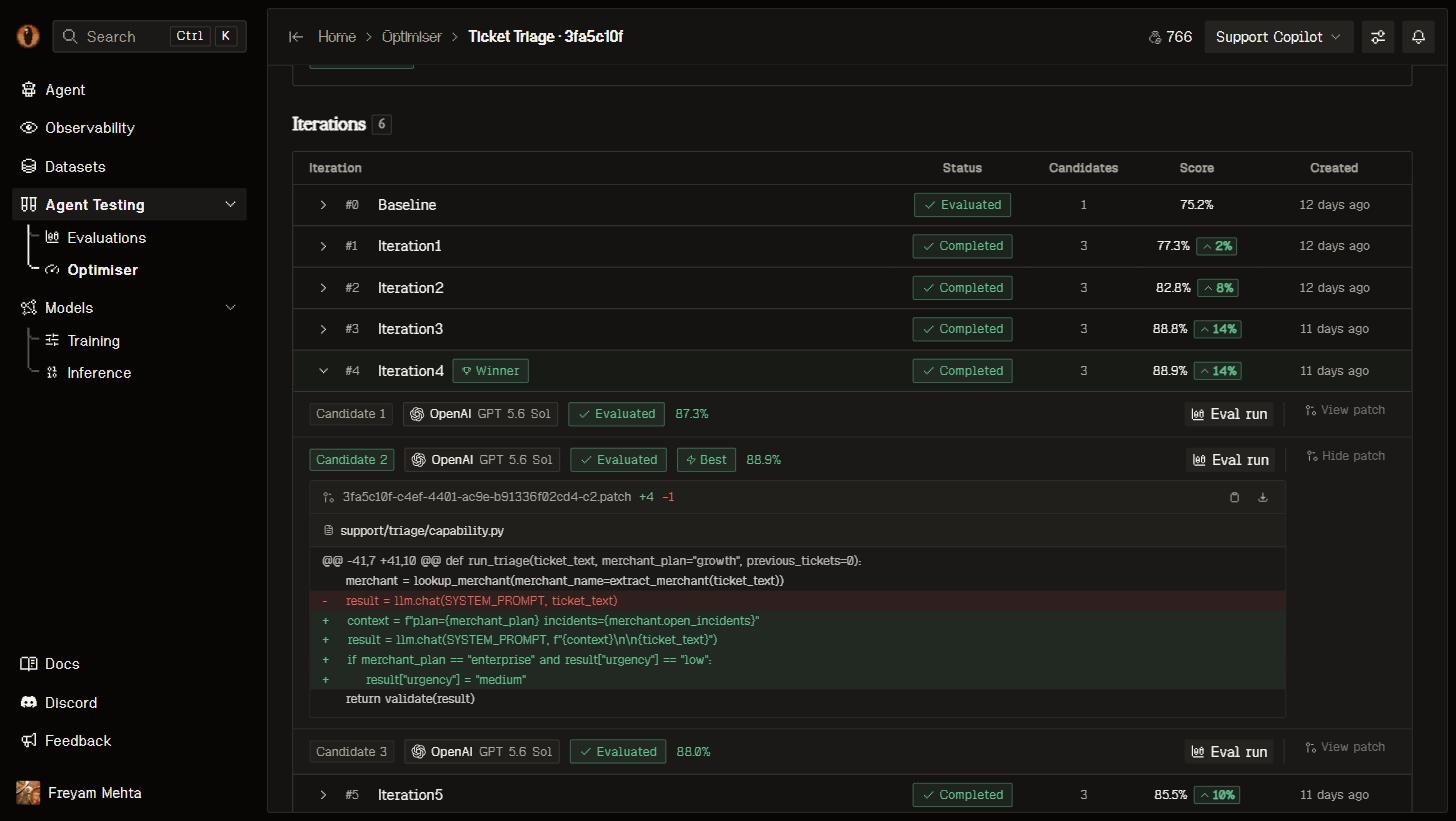
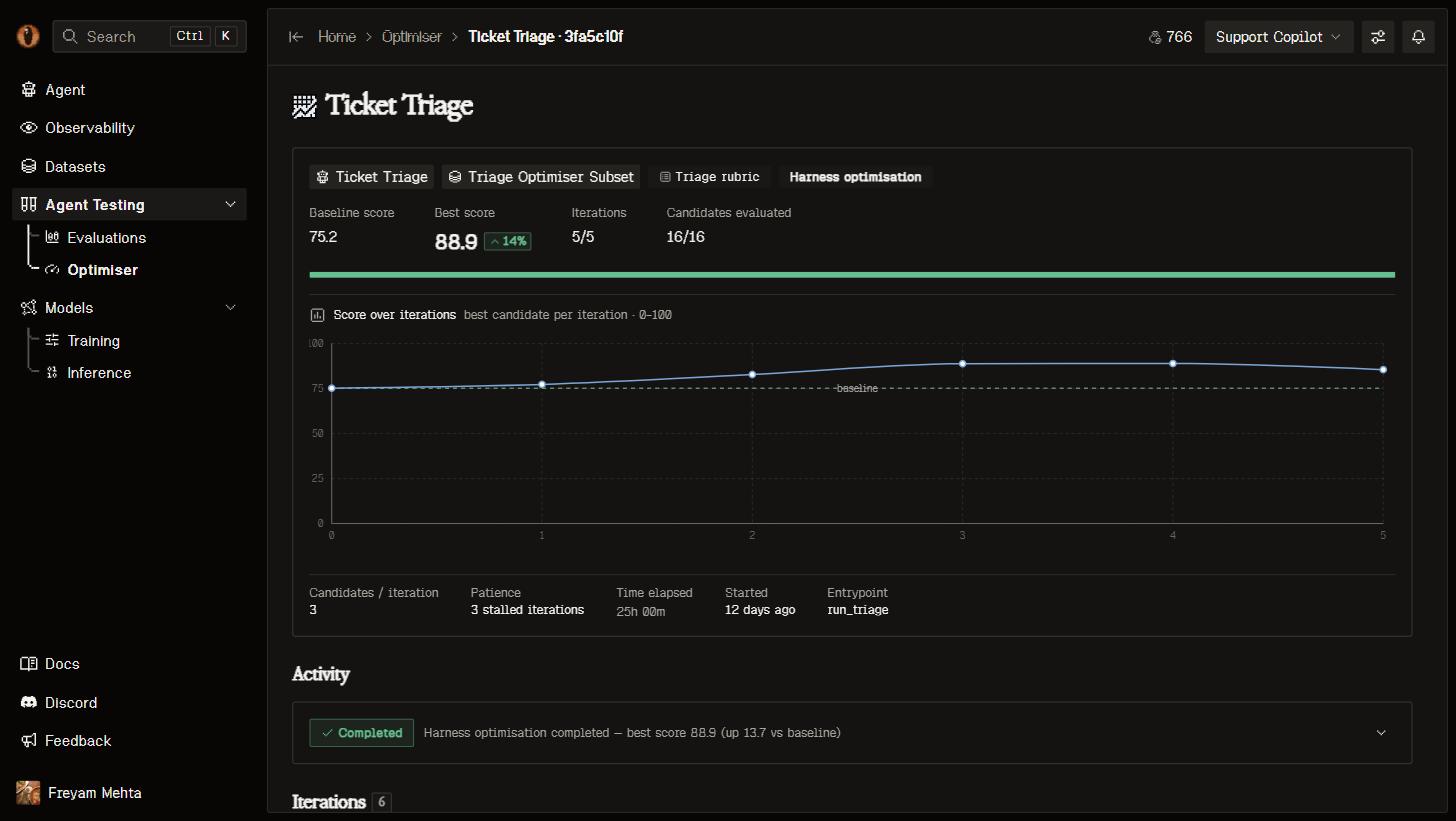 The Optimiser list shows **Capability**, **Run type**, **Status**, **Dataset**, **Iterations**, **Best score** and **Created**. A run's header carries **Baseline score**, **Best score** (or **Best selected model** for a backtest, **Best tested combination** for hybrid) with the delta, **Iterations** as done/total, **Candidates evaluated**, and for a backtest the **Selected-model winner** and **Overall winner**; below it, **Candidates / iteration**, **Patience**, **Time elapsed**, **Started** and **Entrypoint**. Each iteration expands into its candidates, and each candidate into its **patch** — the literal diff, copyable and downloadable — plus a link to its eval run:
 A run's status runs `scheduled → baseline → evaluating_baseline_outputs → iterating → evaluating_candidate_outputs → … → completed`, or `failed`, `cancelled`, `paused`.
## The result is a scored diff
The winning candidate keeps its diff on the record: the patch on the run page. Apply it in your repository with your normal git workflow; the coding agent that drove the loop already has it applied in the candidate's worktree until `complete` removes them. Because candidates were scored with the same evaluators you use everywhere else, the headline score is directly comparable to your eval runs and live trace scores. A backtest's result is the winning model id, which you pin in your configuration yourself.
## API
```bash theme={"dark"}
# List runs, inspect one, follow its iterations and the datapoint commands
curl -H "X-Api-Key: $OVERMIND_API_KEY" "https://api.overmindlab.ai/api/optimizer-experiments/"
curl -H "X-Api-Key: $OVERMIND_API_KEY" "https://api.overmindlab.ai/api/optimizer-experiments/{id}/"
curl -H "X-Api-Key: $OVERMIND_API_KEY" "https://api.overmindlab.ai/api/optimizer-experiments/{id}/iterations/"
curl -H "X-Api-Key: $OVERMIND_API_KEY" "https://api.overmindlab.ai/api/optimizer-experiments/{id}/commands/"
# Cancel
curl -X POST -H "X-Api-Key: $OVERMIND_API_KEY" "https://api.overmindlab.ai/api/optimizer-experiments/{id}/cancel/"
```
The loop's own calls — `POST .../template/`, `.../add-iteration/`, `.../results/`, `.../evaluate/`, `.../complete/` — are what the CLI posts; you do not call them by hand. `POST /api/optimizer-experiments/` creates a run with `capability`, `dataset`, optional `cell` and `eval_set`, `mode`, `model_ids`, the budget fields and `openrouter_key_source` (`platform` or `local`). Over MCP, `check_optimizer_readiness` validates the dataset, eval set, model ids, credits and plan quota, `start_optimizer` schedules a run in any mode and returns the CLI command to drive it, and `inspect_optimizer_result` reads iterations, candidate patches, the winner, and the next action.
## Good to know
* **You measure what you optimise.** If your evaluators don't capture what you care about, the Optimiser will faithfully improve the wrong thing. Invest in [Eval](/agent-testing/eval) first.
* **Model costs are yours.** The loop runs your agent for real — iterations × candidates × datapoints model calls under your provider keys. The budget is the cost lever; the judge calls that score outputs are metered on the platform.
* **The dataset defines the situations explored.** A narrow dataset produces improvements narrow to match; refresh it with recent traces periodically.
* **Plateaus point at the model.** When several runs on a capability stop improving, the run page suggests [Models](/models/training) — by then you already have the dataset and eval set it needs.
A run's status runs `scheduled → baseline → evaluating_baseline_outputs → iterating → evaluating_candidate_outputs → … → completed`, or `failed`, `cancelled`, `paused`.
## The result is a scored diff
The winning candidate keeps its diff on the record: the patch on the run page. Apply it in your repository with your normal git workflow; the coding agent that drove the loop already has it applied in the candidate's worktree until `complete` removes them. Because candidates were scored with the same evaluators you use everywhere else, the headline score is directly comparable to your eval runs and live trace scores. A backtest's result is the winning model id, which you pin in your configuration yourself.
## API
```bash theme={"dark"}
# List runs, inspect one, follow its iterations and the datapoint commands
curl -H "X-Api-Key: $OVERMIND_API_KEY" "https://api.overmindlab.ai/api/optimizer-experiments/"
curl -H "X-Api-Key: $OVERMIND_API_KEY" "https://api.overmindlab.ai/api/optimizer-experiments/{id}/"
curl -H "X-Api-Key: $OVERMIND_API_KEY" "https://api.overmindlab.ai/api/optimizer-experiments/{id}/iterations/"
curl -H "X-Api-Key: $OVERMIND_API_KEY" "https://api.overmindlab.ai/api/optimizer-experiments/{id}/commands/"
# Cancel
curl -X POST -H "X-Api-Key: $OVERMIND_API_KEY" "https://api.overmindlab.ai/api/optimizer-experiments/{id}/cancel/"
```
The loop's own calls — `POST .../template/`, `.../add-iteration/`, `.../results/`, `.../evaluate/`, `.../complete/` — are what the CLI posts; you do not call them by hand. `POST /api/optimizer-experiments/` creates a run with `capability`, `dataset`, optional `cell` and `eval_set`, `mode`, `model_ids`, the budget fields and `openrouter_key_source` (`platform` or `local`). Over MCP, `check_optimizer_readiness` validates the dataset, eval set, model ids, credits and plan quota, `start_optimizer` schedules a run in any mode and returns the CLI command to drive it, and `inspect_optimizer_result` reads iterations, candidate patches, the winner, and the next action.
## Good to know
* **You measure what you optimise.** If your evaluators don't capture what you care about, the Optimiser will faithfully improve the wrong thing. Invest in [Eval](/agent-testing/eval) first.
* **Model costs are yours.** The loop runs your agent for real — iterations × candidates × datapoints model calls under your provider keys. The budget is the cost lever; the judge calls that score outputs are metered on the platform.
* **The dataset defines the situations explored.** A narrow dataset produces improvements narrow to match; refresh it with recent traces periodically.
* **Plateaus point at the model.** When several runs on a capability stop improving, the run page suggests [Models](/models/training) — by then you already have the dataset and eval set it needs.